
How to tell if an apartment complex in Austin is safe
By Ross Quade · Updated 2026-06-28
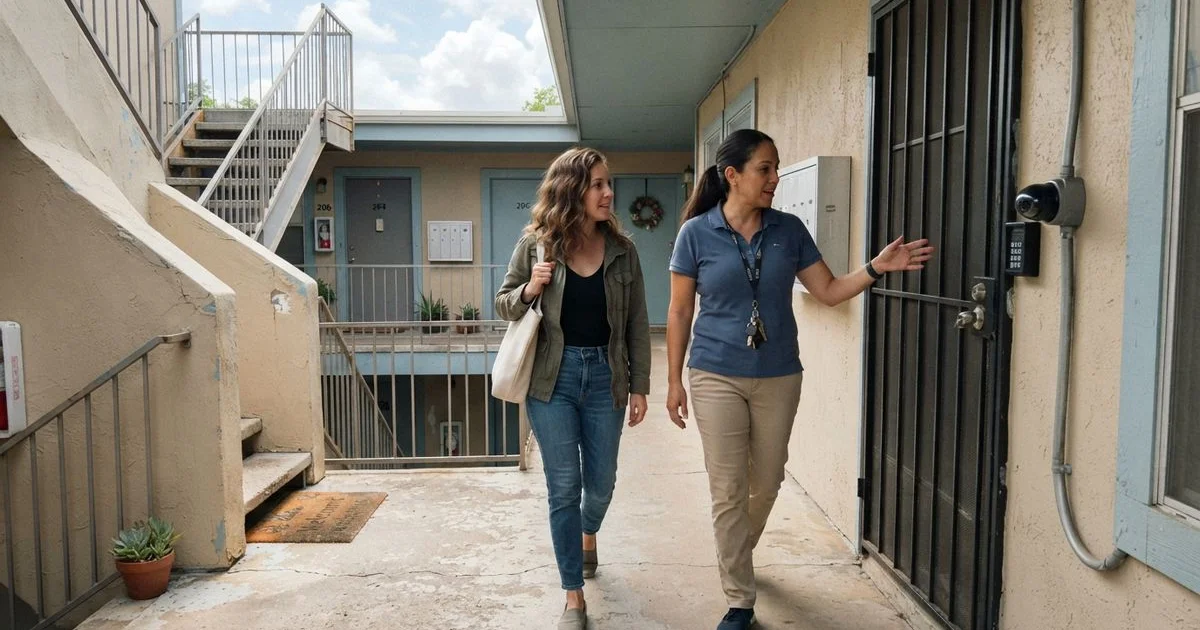
Safety is one of the harder things to evaluate on a single tour, since a well-staged model unit and a friendly leasing agent do not tell you much about how a property actually handles security day to day. A few specific things to check, and the right questions to ask, go a lot further than a general impression.
What to look for on a tour
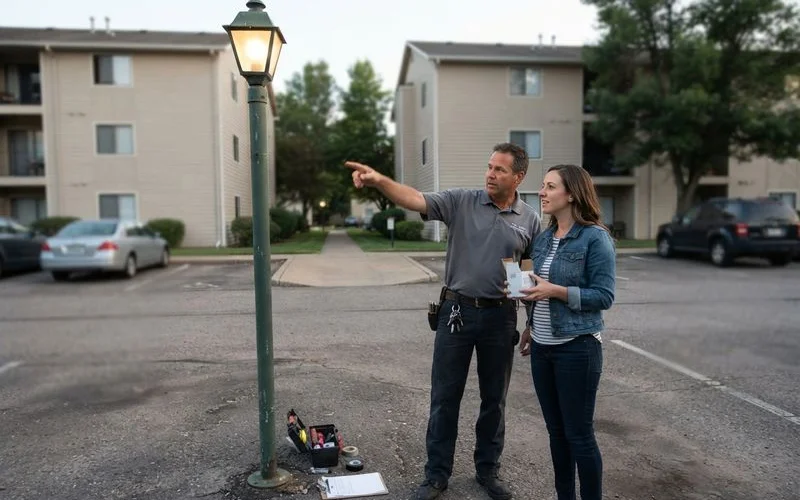
- Exterior lighting. Walk the parking lot and walkways at dusk or after dark if you can, not just during a daytime tour. Burned-out lights in a parking lot or stairwell are a common, checkable sign of deferred maintenance on security basics.
- Gates and access control. Check whether a gate is actually closing and latching, not propped open, and whether visitors can easily tailgate in behind a resident. A gate that looks secure but is routinely propped open provides little real security.
- Package security. Ask whether the property uses secured package lockers or leaves deliveries in an open area near the office or mailroom. Package theft is one of the more frequently reported complaints in Austin apartment reviews.
- Common area condition. Broken fixtures, graffiti, or an unkept pool and courtyard area can be a sign of broader deferred maintenance, which sometimes correlates with lax security follow-through as well. Deferred maintenance can show up as a pest issue too; our guide on pest problems in Austin apartments covers what to check for on the same tour.
Questions to ask the leasing office directly
| Question | What a good answer sounds like | What a vague answer might signal |
|---|---|---|
| Has there been a recent incident here? | A direct, specific answer, even if the answer involves a past issue and what changed | Deflection, or “not that I know of” without detail |
| How is the parking lot lit and monitored? | Specific detail: cameras, lighting schedule, patrol | A general “we take safety seriously” with no specifics |
| How do you handle a broken gate or door? | A stated repair timeline or process | No clear answer or a shrug |
| What is your package security setup? | Named system: lockers, monitored room, etc. | “We’re working on it” or no system at all |
Reading reviews for real safety signals
Look past the overall star rating and search recent reviews specifically for mentions of safety, lighting, break-ins, or package theft. A single old complaint from several years ago matters less than a cluster of recent, specific mentions. Reviews that describe management’s response to a safety concern (fixed quickly vs. ignored for months) tell you more about the property than the incident itself, since no property is entirely free of incidents.
Checking the area, not just the property
A property’s own security measures matter, but so does the surrounding area. Local Austin-area police departments publish crime data by neighborhood, which is worth a quick look for any address you are seriously considering, particularly if you are unfamiliar with a specific part of the metro. Combining that with what you observe on a tour and what recent residents report gives a much fuller picture than any one source alone.
Safety features worth asking about directly
Beyond lighting and gates, ask whether the property has security cameras in parking areas and common spaces, whether there is any on-site courtesy officer or patrol presence, and how the leasing office typically handles a resident’s safety concern once reported. A property that can answer all three specifically and confidently has usually thought about this seriously, rather than treating it as a marketing checkbox.
If you already live somewhere with a safety concern
If you are already a resident and something feels off, a broken gate that has stayed broken for weeks, a pattern of package theft the office seems to be ignoring, put your concern in writing to the leasing office rather than only mentioning it in person. A written record matters if the issue continues and you need to reference it later, whether that is in a follow-up conversation or, in a serious case, a habitability discussion under Texas law.
Putting it together
No single signal, a gate, a review, a crime map, tells the whole story on its own. The strongest approach is combining a daytime and evening visit, a direct conversation with the leasing office about specifics, and a look at both recent reviews and neighborhood crime data before you sign. Our methodology explains how safety-related sentiment factors into how we score the communities in this directory, and Austin Apartment Reviews Guide surfaces recent resident feedback across every category in Greater Austin.
Frequently asked questions
- What are the biggest safety red flags at an apartment complex?
- Broken exterior lighting, propped-open security gates or doors, a pattern of recent package theft complaints in reviews, and vague or evasive answers when you directly ask the leasing office about recent incidents.
- Does gated access actually make an apartment complex safer?
- A gate helps, but only if it is consistently enforced. A broken gate that is propped open, or one residents routinely tailgate through, provides little real protection even though it looks secure on a tour.
- How can I check crime data for a specific area of Austin?
- Local police departments in the Austin area publish crime data and maps for their jurisdiction. Checking the specific area around a property, not just general city-wide statistics, gives a more accurate picture.
- Should I ask about package theft specifically?
- Yes. Package theft is one of the most commonly reported issues in Austin apartment reviews. Ask whether the property uses secure package lockers versus an open pile at the office or mailroom.